Manav Dharma Shastra-Ditiya Skandh: Discovering the True Religion of the Mind and the Universe Within
Posted By: Awadhoot Devidas Seva Sansthan
04 Apr 2026
Manav Dharma Shastra-Ditiya Skandh: Discovering the True Religion of the Mind and the Universe Within
Meta Description: Explore the profound teachings of the Ditiya Skandh in Manav Dharma Shastra. Learn about the secrets of the mind, the unity of all religions, and the spiritual anatomy of the human body.
________________________________________
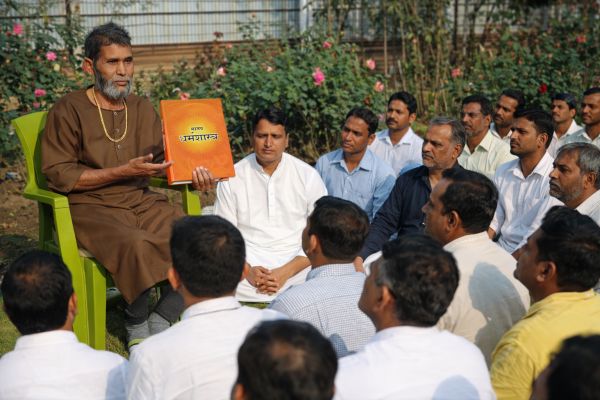
The Ditiya Skandh (Second Section) of the Manav Dharma Shastra is a divine dialogue that dismantles the complexities of religious dogma and reveals the simple, naked truth of existence. Composed by Gurudev Awadhoot Laxminarayan Ji, this section serves as a spiritual masterclass, where the Supreme Father answers the devotee's burning questions: What is real religion? and How can we attain peace?
The text moves beyond external rituals to establish that the ultimate truth lies within the human mind and body. Here is a deep dive into the core spiritual revelations of the Ditiya Skandh.
1. The Mind is the Basis of All Religion
One of the most revolutionary concepts introduced in this section is the idea that religion is not an external set of laws, but a reflection of the internal state.
The text states:
"Man Adhar Sakal Mat Pantha | Man hi hetu Jagat Sab Tanta ||" (The mind is the basis of all creation and beliefs. All conflicts in the world are the creation of the mind.)
The Divine explains that the various religions and paths (Hindu, Muslim, etc.) exist because people interpret the Universal Law through their limited intellects. When the mind is pure, the world appears holy. Therefore, Real Dharma is not about following a specific creed, but about aligning one's mind with the natural laws of the universe.
2. The Core of True Spirituality: Simplicity and Contentment
The Ditiya Skandh provides a clear checklist for a truly spiritual person. It argues that a realized being is defined not by their robes or rituals, but by their internal state. The characteristics of such a person include:
• Simplicity (Saral Sahaj): Being natural and effortless.
• Contentment (Man Santosha): Being happy with what is.
• Non-Judgment: A spiritual being does not criticize or condemn others, nor do they feel superior.
• Absence of Duality: They see the Divine in everyone, erasing the differences between caste and creed.
"Hindu Muslim Dharan Bhae Dharma Na Kou Samjhaye ||" (The differences between Hindu and Muslim have become firm, yet no one has understood the actual Dharma.)
3. The Human Body as a Cosmic Map
This section unveils the mysterious connection between the microcosm (human body) and the macrocosm (universe). It asserts:
"Sakal Bramhand Prabhu Sharira |...| Pind Bhitar Soe Bhramanda ||" (The entire universe is the body of the Divine... Whatever is in the body is in the universe.)
The scripture uses the metaphor of the Body as a City:
• The Nine Gates: The body has nine openings (eyes, ears, nostrils, etc.).
• The King and Queen: The Mind is the King, and the Intellect (Buddhi) is the Queen.
• The Chariot: The body is a chariot, the senses are the horses, and the ego is the flag.
It reveals that Heaven and Hell are not physical locations we go to after death, but states of mind that exist within us right now. When our experiences are pleasant, we are in Heaven (Devlok); when they are painful, we are in Hell.
4. The Secret of Karma and Emotions (Bhav)
The text delves deep into the mechanics of suffering and happiness. It teaches that Emotions (Bhav) are the seeds of Karma.
• Life force (Prana) triggers emotions.
• Emotions drive actions.
• Actions create Karma, which results in pleasure or pain.
To break this cycle, the scripture prescribes the remedy of Divine Remembrance. When one is trapped in the "swamp" of worldly attachment, the grace of the Guru and God pulls the chariot of the mind out of the mud, leading to liberation.
5. Truth and Non-Violence: The Ultimate Flags
What is the root of religion? The Ditiya Skandh answers unequivocally:
"Satya Hi Dharam Nahi Duja Koel | Ahinsa Bhayu Ta Dhwaja Nisana ||" (Truth is the only religion, there is no other. Non-violence is its flag.)
The text explains that rituals performed for selfish gain are not true Dharma. True spirituality is selfless. It is about transcending the feeling of "I" and "Mine" and realizing that the Divine is the doer of all actions.
6. The Unity of Masculine and Feminine Energies
In a beautiful explanation of creation, the text describes the universe as the interplay of Nar (Purush) and Nari (Prakriti).
• Nature (Prakriti): The pulse of the Supreme Spirit, possessing nurturance and motherly qualities.
• Consciousness (Nar): The collective awareness.
Together, they create the universal consciousness. The text emphasizes that since we all come from this one source, distinctions of religion are man-made illusions.
Conclusion
The Ditiya Skandh is a call to turn inward. It teaches that we do not need to search for God in the external world because the entire universe resides within the human body. By conquering the mind, embracing truth, and practicing non-violence, one can attain the state of Paramanand (Ultimate Bliss).
As the text concludes, those who understand this mystery are the true wise ones (Gyani), while those who remain ignorant wander helplessly in the world of illusion.
Keywords: Manav Dharma Shastra, Ditiya Skandh, Gurudev Awadhoot Laxminarayan, Mind and Religion, Spiritual Anatomy, Karma and Emotions, Universal Truth, Non-Violence.
Manav Dharma Shastra is a Sanatan Dharma scripture composed by Gurudev Awadhoot Laxminarayan Ji (Laxminarayan Meena, IPS) under the divine grace of Satguru Awadhoot Devidas Maharaj. This scripture was first published in Hindi in 2013, followed by its English edition in 2022 and Bengali edition in 2023 (Publisher: Kirti Publication; ISBN: 978-81-965006-1-0)
Satyavani Bhajan, Awadhoot Laxminarayan, Awadhoot Devidas Maharaj, Manav Dharma Shastra, Satyavani Sangit Mahotsav,