Posted By: Awadhoot Devidas Seva Sansthan
16 Apr 2026
The Path of Human Dharma and Self-Reflection: Relevance of Manav Dharma Shastra in Modern Life
Learn how Manav Dharma Shastra guides modern life through self-reflection, inner peace, and social harmony. Discover principles to lead a balanced and meaningful life.
Manav Dharma Shastra, self-reflection, human dharma, spiritual life, inner peace, Sanatan Dharma, self-realization, spiritual wisdom
Introduction
Today’s era is marked by speed, stress, and confusion. In the pursuit of external achievements, humans have lost their inner peace. In such times, the concept of “Human Dharma and Self-Reflection” becomes highly relevant.
Saints and sages have always taught that true religion lies not in external rituals but in pure conduct, thoughts, and self-realization. Continuing this divine tradition, Manav Dharma Shastra serves as a practical guide for modern individuals.
What is Manav Dharma or Human Dharma ?
Manav Dhrama or Human Dharma is not limited to any sect or tradition. Its true meaning is:
Practicing humanity
Living with love and compassion
Following truth and ethics
Unless a person overcomes inner vices—lust, anger, greed, and ego—no spiritual practice can be complete.
Modern Problem: External Search, Inner Emptiness
Today, people search for God in temples, mosques, and pilgrimages, while the truth is that God resides within us.
“Tat Tvam Asi” — You are That.
This Upanishadic teaching reminds us that the soul and the Supreme are one.
However:
The mind is trapped in worldly desires
Materialism has overshadowed spirituality
Life has lost its balance
Manav Dharma Shastra: A Practical Guide
This is where Manav Dharma Shastra becomes relevant.
It is not just spiritual philosophy—it teaches practical living.
1. Path of Mental Purification
It teaches:
Purify your mind
Remove negative thoughts
Practice self-reflection
This is the first step toward inner peace.
2. Self-Reflection and Self-Realization
It encourages individuals to:
Look within
Identify weaknesses
Understand the true nature of the soul
When one realizes inner power, they understand that the same divine essence exists in all.
3. Foundation of Social Harmony
Society today is divided by caste, religion, and ideology.
Manav Dharma Shastra teaches:
True religion is humanity
All humans are one
Love and service are the essence of Dharma
4. Principle of Balanced Living
It teaches balance:
Understand destiny, but don’t be trapped by it
Live materially, but don’t get lost in it
Practice spirituality without show
5. Freedom from Stress and Confusion
Modern life is full of anxiety and dissatisfaction.
Manav Dharma Shastra:
Stabilizes the mind
Brings clarity
Provides inner peace
It acts like a light in darkness.
How to Apply in Life ?
Cultivate love within
Serve others
Follow truth and ethics
Practice daily self-reflection
Conclusion
The path of Human Dharma and Self-Reflection is simple and practical.
Manav Dharma Shastra teaches:
True religion lies within
God resides inside us
Self-realization is the ultimate goal
“Not in temples, nor in mosques,
Not in sacred places afar,
One who Seeks within themselves,
Finds the Divine instantly.”
Manav Dharma Shastra is a Sanatan Dharma scripture composed by Gurudev Awadhoot Laxminarayan Ji (Laxminarayan Meena, IPS) under the divine grace of Satguru Awadhoot Devidas Maharaj. This scripture was first published in Hindi in 2013, followed by its English edition in 2022 and Bengali edition in 2023 (Publisher: Kirti Publication; ISBN: 978-81-965006-1-0)
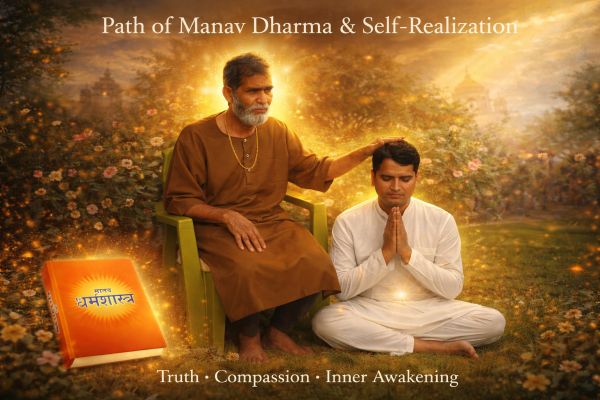
Well wishes shared by well-wishers offer heartfelt messages of support, appreciation, and inspiration. These testimonials highlight the positive impact of Awadhoot Devidas Seva Sansthan on individuals and the community, reinforcing its mission and values.
Gurudev
Gurudev Lakshminarayan Ji was born on June 10, 1970, in a farmer's family in the village of Bahadurpur, located in the Alwar district of Rajasthan. From an early age, he had a deep interest in spiritual contemplation, rooted in his past karmic impressions and familial upbringing. His life was profoundly influenced by his Satguru Awadhoot Devidas Maharaj Ji, mother Jhooma Devi Ji, and elder brother Shivcharan Ji. Lakshminarayan Ji completed his M.A. from Rajasthan University and, with the blessings of his Satguru, was selected into the Indian Police Service (IPS) in 1998, being allotted the West Bengal cadre. In the year 2000, by divine grace, he married the noble and spiritually inclined Mrs. Keerti Ji. They were blessed with two daughters, Akshara Narayan and Neerja Narayan. Both husband and wife shared a deep spiritual inclination, which made it easier for him to ascend the heights of spiritual realization. Through the grace of his Guru, he unveiled the most subtle mysteries of the Supreme Power with a scientific approach and presented them to the general public in an understandable way. His writings reflect a profound divine energy and have served as a healing elixir for the welfare of society and humanity. His literary work transcends boundaries of caste, creed, and sectarianism, and therefore, scholars from all faiths have warmly welcomed his writings. By "filling an ocean into a pitcher," he has initiated a new chapter in the history of humanity—reviving a humanistic and egalitarian perspective after nearly 500-600 years. Gurudev Lakshminarayan Ji’s life is a unique confluence of spirituality, service, and wisdom. In today's age, he stands as a source of inspiration for true seekers and thinkers alike.
Satgurudev
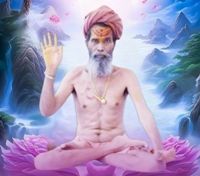
Awadhoot Devidas Ji was born in the village of Ghosrana in the Alwar district of Rajasthan into a Jat farmer family. His father's name was Mansukh, and his mother's name was Maharaji. From an early age, he was spiritually inclined, and at just 11 years old, he renounced his home in search of the Supreme (Brahma). He took initiation from the enlightened Guru Kajordas Ji and accepted a life of renunciation. Devidas Ji was the only disciple of Kajordas Ji. His Guru gave him the sacred Ram Mantra and instructed him to detach from worldly life and undertake intense penance. Devidas Ji lived in the dense forests of Sariska, surviving on grass and leaves while engaging in deep meditation. Later, he practiced extreme austerity for 12 years, living only on air (Vayu Ahari). Impressed by his disciplined and intense penance, a divine voice (Akashvani) granted him a boon. However, Devidas Ji, completely detached due to the power of the Guru Mantra, refused to ask for any boon. The divine voice then blessed him with immortality (Ajara-Amara), selfless devotion (Nishkaam Bhakti), and the complete realization of Brahma. He was told that from that day on, he would be known as “Awadhoot,” free from all karmic bondage and forever established in the supreme spiritual state. Upon attaining this state, Awadhoot Devidas Ji realized that energy is power, power is Brahma, Brahma is indivisible, and all of humanity is one. With this realization, he left the forests of Sariska and began traveling from village to village, spreading the message of humanity. He strongly opposed superstition and blind rituals, instead promoting true human values and spiritual wisdom in simple language. His life was completely dedicated to spiritual practice, selfless service, and devotion to his Guru. He never indulged in magical or showy behavior, and emphasized that total surrender to the Guru is the essence of spiritual practice. Everyone who came in contact with him was spiritually uplifted. Awadhoot Devidas Ji’s life is a shining example of how true devotion, discipline, and service to humanity can elevate a person to extraordinary spiritual heights and inspire countless others on the path of truth.